DOSING & ADMINISTRATION

OXERVATE® Is an 8-Week Eye Drop
Regimen Delivered Directly to Your
Patients

Instill 1 drop in the affected eye(s)
6 TIMES DAILY

AT 2-HOUR INTERVALS

FOR 8 WEEKS

OXERVATE can be stored at room temperature for up to 12 hours
and up to 77 °F (25 °C) after being taken out of the refrigerator.

Resources are available to help patients
get started and stay on OXERVATE
.

Explore resources

Important administration information
to relay to patients starting on OXERVATE

CONTACT LENSES

Contact lenses should be removed before applying OXERVATE and may be reinserted 15 minutes after administration.

MISSED DOSE

If a dose is missed, treatment should be continued as normal at the next scheduled administration.

CONCOMITANT USE WITH OTHER TOPICAL PRODUCTS

If more than 1 topical ophthalmic product is being used, administer the eye drops at least 15 minutes apart to avoid diluting products. Administer OXERVATE 15 minutes prior to using any eye ointment, gel, or other viscous eye drops.

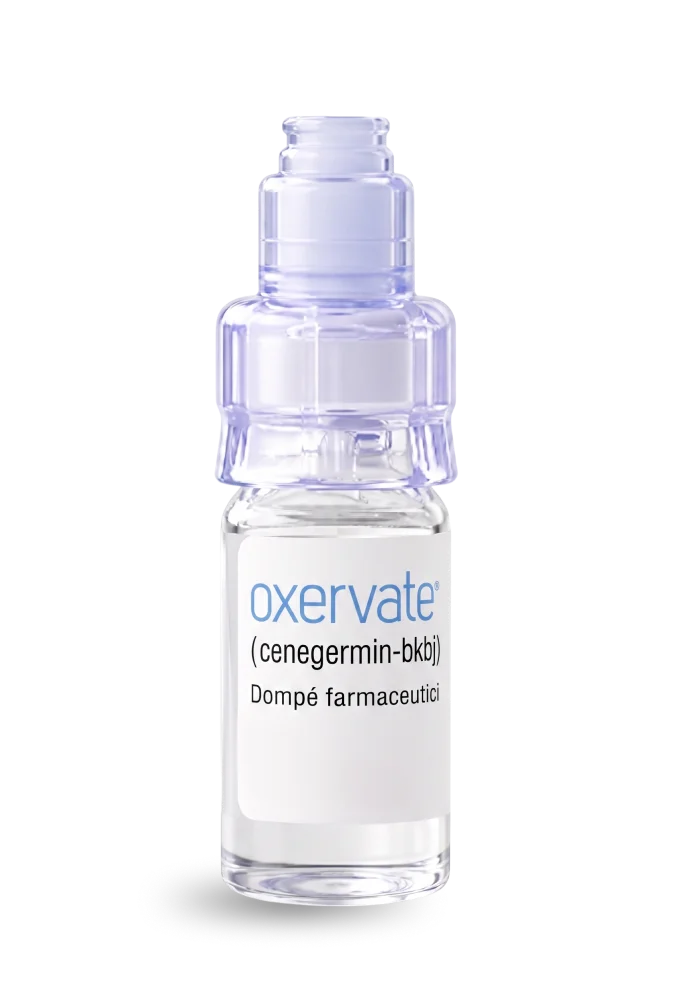
A 14-day supply of OXERVATE is mailed to your patients every 2 weeks

Patients receive 2 cartons of OXERVATE, each containing 1 week of treatment and supplies

1 VIAL ADAPTER for each day + 1 extra
6 PIPETTES for each day + 3 extra

6 DISINFECTANT WIPES for each day + 3 extra
1 DOSE RECORDING CARD for the week

OXERVATE is stored in the refrigerator
until it is ready for daily use

Upon receiving the carton of OXERVATE
treatment, patients should:

Remove the carton(s) from the insulated pack within 5 hours and store in the refrigerator (36 °F to 46 °F [2 °C to 8 °C]).

Remove only the number of vials needed for 1 day from the weekly carton. Do not shake them.

Opened vials can be stored at room temperature (up to 77 °F [25 °C]) or in the refrigerator (36 °F to 46 °F [2 °C to 8 °C]) and should be discarded after 12 hours.

An open vial of OXERVATE can be stored at room temperature or in the fridge for up to 12 hours

Patients with questions about OXERVATE
can reach Accredo Specialty Pharmacy 24/7

Learn more

Sign up for resources and new information

For US healthcare professionals only.

This field is for validation purposes and should be left unchanged.
Fields marked with an asterisk are required.
Name(Required)
Consent to Marketing Communications and Data Use

By checking this box and submitting this form, I consent to Dompé collecting, using, and processing the personal information I provide, including information that may relate to my health condition or treatment, to send me educational materials, product information, support resources, market research communications, and other marketing information about OXERVATE® or related services.

I understand that Dompé may share my information with service providers, contractors, business partners, or vendors acting on its behalf to deliver these communications and services. My information will not be sold.

I understand that providing this consent is voluntary, there is no cost to me, and my decision will not affect my ability to receive OXERVATE or any other medical care or medications.

I may withdraw my consent at any time by following the instructions in the Privacy Policy.

By clicking SUBMIT, you agree to our Terms of Use and Privacy Policy.

This site is protected by reCAPTCHA.

Indication and Important Safety Information

WARNINGS AND PRECAUTIONS

Use with Contact Lens
Contact lenses should be removed before applying OXERVATE because the presence of a contact lens (either therapeutic or corrective) could theoretically limit the distribution of cenegermin-bkbj onto the area of the corneal lesion. Lenses may be reinserted 15 minutes after administration.

Eye Discomfort
OXERVATE may cause mild to moderate eye discomfort such as eye pain during treatment. The patient should be advised to contact their doctor if a more serious eye reaction occurs.

ADVERSE REACTIONS
In clinical trials, the most common adverse reaction was eye pain following instillation which was reported in approximately 16% of patients. Eye pain may arise as corneal healing occurs. Other adverse reactions occurring in 1% to 10% of OXERVATE patients included corneal deposits, foreign body sensation, ocular hyperemia, ocular inflammation, photophobia, tearing, and headache.

USE IN SPECIFIC POPULATIONS

Pregnancy
There are no data from the use of OXERVATE in pregnant women to inform any drug associated risks.

Lactation
The developmental and health benefits of breastfeeding should be considered, along with the mother’s clinical need for OXERVATE, and any potential adverse effects on the breastfed infant from OXERVATE.

Pediatric Use
The safety and effectiveness of OXERVATE have been established in the pediatric population. Use of OXERVATE in pediatric patients 2 years of age and older is supported by evidence from adequate and well-controlled trials of OXERVATE in adults with additional safety data in children.

INDICATION
OXERVATE® (cenegermin-bkbj) ophthalmic solution 0.002% (20 mcg/mL) is indicated for the treatment of neurotrophic keratitis.

DOSAGE AND ADMINISTRATION
Instill one drop of OXERVATE in the affected eye(s), 6 times a day at 2-hour intervals for eight weeks.

To report ADVERSE REACTIONS, contact Dompé U.S. Inc. at 1‌-‌8‌3‌3‌-‌3‌6‌6‌-‌7‌3‌8‌7 or FDA at 1‌-‌8‌0‌0‌-‌F‌D‌A‌-‌1‌0‌8‌8 or www.fda.gov/medwatch.

Please see full Prescribing Information for OXERVATE.

Reference: OXERVATE® (cenegermin-bkbj) ophthalmic solution 0.002% (20 mcg/mL) [US package insert]. San Mateo, CA: Dompé U.S. Inc.; 2024.

Indication and Important Safety Information

OXERVATE® (cenegermin-bkbj) ophthalmic solution 0.002% (20 mcg/mL) is indicated for the treatment of neurotrophic keratitis.

WARNINGS AND PRECAUTIONS

Use with Contact Lens
Contact lenses should be removed before applying OXERVATE because the presence of a contact lens (either therapeutic or corrective) could theoretically limit the distribution of cenegermin-bkbj onto the area of the corneal lesion. Lenses may be reinserted 15 minutes after administration.

EXPAND